
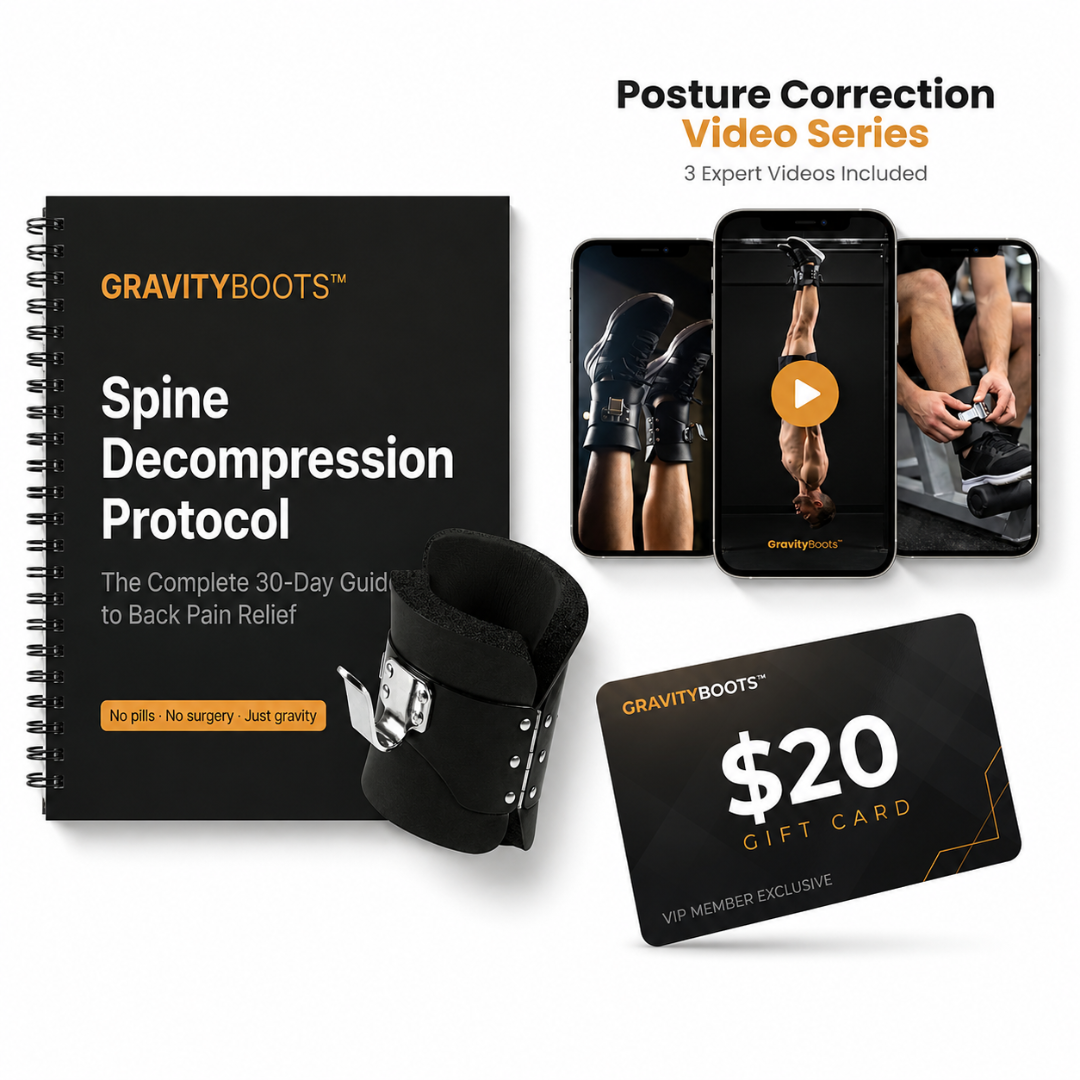

How to start taking care of your spine at home?
What is spinal compression — and why it's behind most back pain?
Spinal compression is a chronic and progressive condition. Every hour you spend sitting, standing, or lifting, gravity pushes your vertebrae closer together. Over time, the discs between them lose fluid, height, and flexibility.
This is the root cause behind most back pain, sciatica, herniated discs, stiff mornings, and poor posture — not a disease, not a weakness. Just gravity doing its job, unchecked.
The problem is that most people treat the symptom — pain — without ever addressing the cause. And so the pain always comes back.
What does spinal compression feel like?
·Lower back pain that gets worse as the day goes on — especially after sitting.
·Stiffness and tightness every morning when you get out of bed.
·Shooting pain from the lower back down one or both legs (sciatica).
·Tightness and soreness in the lower back after training or lifting weights.
·A constant feeling of pressure or "fullness" in the lumbar area.
·Reduced mobility — difficulty bending, rotating, or reaching without discomfort.
·Pain that keeps you awake at night or wakes you in the early hours.
What to do if you have chronic back pain or spinal compression?
Surgery? Don't worry — that's the last resort
- Physiotherapy -> Effective but requires appointments, time, and $50–80 per session. Results are often temporary without ongoing visits.
- Chiropractic ->Provides relief but the same recurring cost and dependency. Treats symptoms, not the structural cause.
- Medication -> Reduces pain temporarily. Doesn't address compression. Long-term use carries side effects and creates dependency.
- Inversion Therapy (recommended)-> Uses gravity to actively decompress the spine. Can be self-administered at home. Addresses the root cause — compression. Available with inversion tables or gravity boots.
What to do if you have chronic back pain or spinal compression?
Stage 1 Mild Compression -> Morning stiffness, occasional lower back tension after sitting. Discomfort is manageable and comes and goes. Most people ignore it at this stage.
Stage 2 Chronic Pain -> Disc height loss begins. Pain becomes constant or recurring. Sciatica-like symptoms may appear. Posture starts to deteriorate visibly.
Stage 3 Structural Damage -> Herniated or bulging discs. Nerve compression with radiating leg pain. Significant loss of mobility. Surgery may become the only option.
If you are in stage 1 or 2 — this is the best moment to act. You can still control the progression, reduce symptoms, and prevent it from advancing. It's not about causing alarm — it's about not ignoring the signs.

After years at a desk job, my lower back started taking over my life.
Mark noticed it slowly:· Waking up stiff every single morning· That dull ache that built up through every workday· His posture getting worse without knowing why"I wasn't injured. I hadn't done anything wrong. I just sat — and sat — and sat."He tried physio. It helped. Then stopped helping. Then started costing too much to keep up. I didn't want surgery. I didn't want to be dependent on pills. I just wanted to feel normal again.